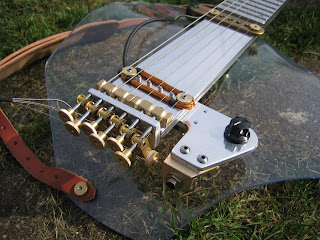
As I describe here, things have slowed down considerably since this summer. It quite typical to me (and probably many others), that planning is easy, but when I get to the point of actually making the things I've been planning, the progress goes down.
In the meantime, until I get the motivation for taking the T-beam guitar some steps further, I might as well plan even more. ...and consider alternative methods for future guitars.
One of the issues I prefer to think of is the possible tuner systems for headless guitars. On Building the Ergonomic Guitar, there's much discussion around how to make a headless tuner system. See e.g. here and here.
I'd like to add another possible principle to the discussion: Using a bicycle brake cable tensioner. It is normally used to tighten the brakes of a bicycle by turning the nut with the rubber ring seen here
(click the images for a better view). Since the threaded, cylindrical part of the tensioner has a flat area which fits a hole of the same shape in the brake arm, it will not turn (but only slide) when the nut is rotated. On a bicycle, as seen here
, the outer cable stops at the tensioner, and the inner cable goes through it and is fastened on the other arm of the brake.
When using it as a guitar tuner, the string passes through the cylinder (the part with the outer thread)
and the total of six tuners/tensioners should be mounted in a brace with six holes of the shape that allows the cylinders to slide, but not to rotate . By turning the individual nuts (the part with the rubber ring), the strings are tuned.
Of course, there's no need to use dedicated bicycle brake cable tensioners. It might be better to make the tuners from pieces of threaded rod with a hole drilled through them plus some knurled knobs such as these . Choosing three knobs of each of the two types shown in the picture would even allow for a staggered placement of the knobs, in turn allowing bigger knobs than with an in-line configuration.
I'd expect it to look like this.
It seems to me to be one of the simplest solutions to the problem of making cheap, accurate and reliable tuners for a headless guitar. I may have overlooked some problems with the principle, so prototyping must be the next step. Once I've finished the T-beam guitar.
Sunday, 11 November 2007
More beating around the bush
Saturday, 6 October 2007
The desired design expression of the T-beam guitar
Very early in the design process, I've had a quite clear idea of what the T-beam guitar will look like. I expect the combination of wood and aluminium to result in a very classic look. Not classic in the guitar sense, but rather in an automotive sense.
From when I was young, I've liked the steering wheels of old sports cars. This particular type of wheel had a body made from steel or aluminium with a wooden rim riveted to it.
English Walnut, © Mike Lempert, used with permission
To me, such a wheel was (and actually still is) one of the classiest single modifications, you could make on your everyday car. My then brother-in-law had a Nardi wheel of this type in his otherwise very ordinary Toyota Corolla. It was back before you had airbags and various controls in the steering wheel, so it was a relatively easy modification. All you had to mount on the new wheel was the button for the horn. I borrowed the car for a while and came to appreciate the wheel for its ergonomics as well as its good looks.
The essential thing of such a steering wheel - design wise - is the thick body of metal sandwiched between beautiful wood, often riveted to the body.
Bolivian Rosewood, © Mike Lempert, used with permission
This much talk about the steering wheels might lead one to believe that they will be the major focus of design. This is not the case; the wheels are just a great source of inspiration. I am not building a steering wheel themed guitar. I don't want people to think "steering wheel" when they see the guitar. But I am looking for the same design expression. The same expression which, by the way, can also be found in some knives with wooden handles.
© Donovan Govan, Chef's Knife, subject to GNU Free Documentation License, Version 1.2
Since the T-beam guitar is made from a relatively thick aluminium beam with body, neck and fretboard made from wood, it almost automatically will have the same type of look as steering wheels and knives described above. Still, there are things I can do to make the style of the guitar even more in the direction of "wood riveted to metal". For example, I plan on using brass discs for fret markers. This way, the markers will resemble the rivets holding the rim of the steering wheel. Also, I plan on using a fairly dark wood, preferably walnut - as on the steering wheel in the first of the above pictures.
I hope the above gives an idea of what I am aiming for. If it also explains why I expect the T-beam guitar to be phenomenally beautiful, I'll consider this attempt of explanation a success.
Wednesday, 12 September 2007
In the meantime...
It's been a while since my last update. This is primarily due to other, more pressing tasks in life. I haven't done any work on the T-beam guitar, except from a lot of thinking.
In the meantime, I've made a modification to my old Squier Strat. Mostly because I am going to need a functioning guitar during the many months, I expect the T-beam construction to take. But also to get a feel at using a router on aluminium. Plus to try out the pickups, which I bought for the T-beam.
My modified strat with neck only, parallel, bridge only, series, parallel+counterphase and series+counterphase switching options.
The modification consists of an aluminium pickguard, the two Seymour Duncan single coil format humbuckers (a Little '59 for the neck and a Jeff Beck Junior for the bridge), a concentric pot for tone and volume plus a six-way rotary switch allowing combinations of serial/parallel and phase/counterphase pickup configurations.
First step was soldering wires to the six way switch. The wiring diagram can be seen here (go to "Switching between two humbuckers"). It took quite some time and was way less straightforward than it looks on the diagram. Not that it was difficult as such, but with 28 lugs (also counting those connecting to the pickups), there was quite a lot of wires crossing one another - and many possible mistakes to be done.
Next step was making the pickguard. I had an old piece of thin aluminium lying around, and I traced the contours of the original pickguard on it with a permanent marker. I also traced the contours of the screw holes and pickup holes except for the middle one. Rough cutting was done with a pair of tin snips. I used my new plunge router and a router table for the next step of shaping by putting the pickguard flat on the router table and by freehand letting the contour, which I'd traced on the aluminium, follow the router bit.
Routing the edges
This was followed by putting my belt sander on its back and smoothing the edges of the pickguard on the belt. The result was pretty nice, but I had to finish the edges with a small rotary tool to get them sufficiently smooth.Pickup holes were made by drilling most of the hole with an ordinary drill and following the above process - except for the belt sander - for finishing.
Not that shaping such a relatively thin sheet of aluminium gave me a lot of aluminium routing experience. The aluminium bars for the T-beam are ten times as thick and will be quite different to handle - but still... it gave me an idea of the amount of shavings, such a process produces. And I feel a little more confident routing the T-beam now. I'm still going to need more practice, though.
Fragile pickups repaired
Having finished the pickguard, I mounted the pickups, switch and concentric pot on it. I had to repair the pickups with electrical tape since their outer plastic shells had become loose. They were brand new, and I didn't drop them or treat them violently in any way, so it's a bit of a disappointment that Seymour Duncan makes such fragile pickups.
Almost finished, I soldered ground wires from bridge and jack. The knobs for the concentric pot had to be drilled in order to fit the pot shaft. I did so with a handheld drill, and I didn't drill completely straight, so the knobs are a bit skewed. I guess I should have been either a: more attentive, or b: using a drill press. I'll go buy me a drill press for the future.
Many wires on one switch
It gave a bit of trouble mounting the six way switch in the pickguard. After I mounted it, it was very hard to turn. After disassembly and assembly, it worked decently, but not completely smooth. It'll have to do for now, but I'll have to look further into it some day.
The sound is really good. I especially like the counterphase settings, which give a more bubbling and buzzy sound. Apart from a tendency not to work on the "bridge pickup only" setting unless wiggled a bit, the six way switch is very convenient.
The looks of the finished guitar is nothing particular. The creme colour of the guitar certainly does not match the aluminium pickguard very well. I could paint the guitar. Or cover the pickguard in brown or burgundy leather. I could even make a similar pickguard in copper.
There's lots of things, I could do, but I'd better start concentrating on the T-beam.
Wednesday, 8 August 2007
The aluminium bars have arrived
The flat bars of aluminium, which I ordered, have arrived. If I arrange them as a T-beam and add the other components I have already bought, it looks like this.
The guitar is almost complete, right? All that's lacking is some wood.
Not exactly. I can see the following steps ahead of me:
- Plan exact geometry of the T-beam.
- Decide/calculate placement of bridge and pickups
- Cut and route top flange
- Cut and route bottom flange
- Bolt and epoxy glue the two flanges together.
- Cut fingerboard and epoxy glue it to top flange.
- Mount frets.
- Design and make locking nut from a piece of brass.
- Level and dress frets.
- Drill holes for bridge and mount bridge
- Put on strings, test how much too high the action is.
- Route recess for lowering bridge.
- Cut wood for neck and body
- Sand wood parts
- Stain and oil wood (I'll probably use spruce for the first version, but I'd like it to look like walnut).
- Mount wood parts.
- Wire electronics (pickups, pots and jack).
- Mount electronics.
- Mount strings.
- Play.
- Adjust.
- Play some more.
- etc...
I guess it'll take more than just a couple of months before this can actually be called a guitar. That's all right. I'm not in a hurry.
Sunday, 5 August 2007
Visionary lutherie
The other day, I stumbled upon an interesting and very inspiring website: KTL guitars . It is run by a Norwegian luthier, Knut Tore Ljøsne, who builds a number of very different guitars - different from one another as well as different from all the rest.
In an earlier post, I wrote about the possibility of using traditional tuners behind the bridge and having the strings go through the top of the guitar. Knut Tore actually did that on his Evil Axe guitar. He reports some tuning stability problems, but thinks that without a vibrato arm (which the Evil Axe has), it would be pretty simple to make it work properly. Since I've never been particularly fond of vibrato arms and don't intend to have one on the T-beam, that makes his approach very usable for a possible future guitar of mine (the first version will use a Schaller fine-tuning bridge).
Close up of the Evil Axe's tuners, copyright Knut Tore Ljøsne, used with permission
The Evil Axe is a remarkably beautiful instrument. Especially since everything on it - the arm rest, the horn for the strap, the two horns making up the thigh support - are there for a purpose (yes, I am a form follows function guy). It has no fancy elements "just for decoration" - perhaps except for the Strat-headstock-esque end holding the tuners, which nevertheless looks brilliant.
Evil Axe guitar, copyright Knut Tore Ljøsne, used with permission
Another of Knut Tore's guitars is the Magnum 648, Which is a lot more futuristic in its design. The body is made from a combination of wood and aluminium. Like the Evil Axe, it is a headless guitar, but it uses a Floyd Rose bridge instead of the Evil Axe's traditional tuners. Knut Tore has used an ordinary hand held router and woodworking routing bits for the aluminium part - just as I intented to do on the T-beam - and has kindly provided a couple of tips and tricks, which I look forward to employing when I start metalworking myself.
Magnum 648 , copyright Knut Tore Ljøsne, used with permission
Knut Tore's approach to guitar building involves a lot of computer modelling before the actual build. This allows for the wide variety in his guitars, since there is a greater probability that a guitar with a new design will actually sound good. Without modelling - or a very good ability to predict the acoustic characteristics of a new design - most luthiers are confined to more or less using the same proven formula for every guitar they build.
There are other very visionary and beautiful (and beautifully sounding) guitars on Knut Tore's website. I've just mentioned the two, which have most things in common with my own project. Go have a look.
Saturday, 28 July 2007
Making my own T-beam
As mentioned earlier, I've had an unexpected hard time finding a suitable T-beam. There are lots of them available, but none wide enough for me to make holes for the pickups without intersecting the top flange completely.
For now, I have given up on finding a T-beam, and I will be making my own. It will consist of a 120 mm (4.7") wide and 10 mm (0.4") thick flat bar of AlMgSi0,5, also known as 6063 Aluminium, which will act as the top flange of the t-beam. The vertical part of the T will be a 30 x 10 mm (1.2" x 0.4") AlZnMgCu 1,5 (aka 7075 aluminium).
6063 is a fairly soft aluminium which should make it fairly easy to shape the neck, make holes for the pickups and make a recess where the bridge will be (otherwise the bridge will be too high). I've heard that it is so soft that it can be difficult and "gummy" to shape, but I could't get a piece of 6061 Aluminium, which was my preferred alloy. We shall see how much of a problem it'll pose.
7075, on the other hand, is very hard and strong, which is nice because the vertical flange will have to withstand the pull of the strings. It will be more difficult to drill, saw and file, but fortunately, the shaping needed on this bar is much simpler than on the top one.
I plan to join the two bars with screws and two component epoxy adhesive.
I ordered the bars yesterday, so now it should only be a matter of days before I can get going. All in all, I'm quite satisfied with the solution. I'd have preferred a "real" T-beam, but this solution allows me to have a stronger alloy where it really matters: The bottom flange.
Friday, 13 July 2007
A different tuner system for headless designs
The guitar I'm planning at the moment might be the first in a series. If it turns out well and the building process is fun (the planning sure is), I expect to build another one. And probably then another. And so on. If the guitar turns out sounding horribly and/or the building is hell, I guess that'll be it. But that hasn't happened yet, so for the moment, I'm happily planning features for future models.
As mentioned earlier, I've settled for the Schaller fine-tuning bridge for the first version of the T-beam. This will avoid a number of potential problems and make the construction more straightforward. I am fine with that. For the next version, however, I have a sleek and efficient tuner design in mind.
The system consists of six arms mounted with one end on a shaft below the top flange of the T-beam. Approximately two thirds to the far end from the shaft, the string attaches to the arm (after going over the bridge and through a hole in the top flange) and is secured either by its ball end or by a screw. The latter solution will allow me to use the ball end at the nut, eliminating the need for a locking nut.
For each arm, a screw is mounted through the top flange. The end of the screw presses down on the arm. Tightening the screw results in pressing down the arm and tightening the string. If the aluminium is strong enough, the threads will be made directly in the top flange. If not, I'll insert some threaded steel or brass bushings.
The picture shows the guitar with one arm only. It is supposed to have six - one for each string.
By selecting steeper or shallower thread for the screws or various lengths of the arm, one can decide how much adjustment is needed for a given change in tuning. An obvious idea is to have a greater ratio for the thicker strings, since it takes more force to tune them.
My rough measurements say that it takes about 4 mm (0,16 inch) to tune the string an octave. That means that there is lots of room for the travel of the arm, even with a relatively thin body.
The idea goes well with using a T-beam, since it uses the top flange for mounting the arm and screw. But actually, I think it can be made as a modification for a wooden guitar as well - all you have to do is route out a cavity for the tuner system and mount it all on a steel or aluminium sheet.